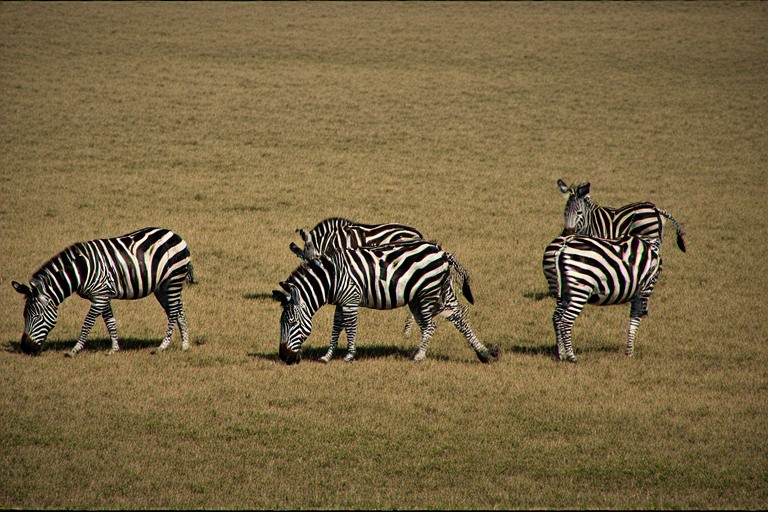
A group of zebras graze peacefully in a vast, dry savanna, their striking black and white stripes contrasting with the muted tones of their environment, creating a visually arresting natural portrait.
The image is composed with the zebras spread across the lower half of the frame, occupying the middle ground and drawing the viewer's attention. They are positioned from left to right, with one zebra grazing to the far left, another pair clustered in the center, and two more to the right, creating a sense of a small herd at rest. The framing emphasizes the open expanse of the savanna, with ample negative space in the sky and background, suggesting the vastness of their habitat. The overall arrangement feels natural and unposed, capturing a typical scene of wildlife in its natural setting.
The key subjects are five zebras, each characterized by their distinctive and unique striped patterns, a hallmark of their species. Their coats are a bold arrangement of black and white stripes that vary in width and pattern from one individual to another, providing both camouflage and individual identification. Their bodies are muscular and robust, typical of grazing animals. Most of the zebras are depicted with their heads lowered, actively grazing on the dry grass. One zebra on the far right stands with its head slightly raised, appearing more alert, while two in the center are positioned closely together, one seemingly standing behind and slightly above the other. Their legs are positioned for stability and movement, with their tails hanging loosely.
The image is a photograph, likely captured with a telephoto lens to isolate the subjects from a distance. The technical execution highlights a keen eye for composition and animal behavior. The style is realistic and documentary, focusing on the natural beauty and patterns of the zebras and their environment. There are no overt artistic interventions; the creative choices lie in the moment captured, the framing, and the post-processing, which appears to enhance the natural contrast and color saturation subtly. The focus is sharp on the zebras, with a slight softening of the background, typical of wildlife photography that aims to draw attention to the main subjects.
The setting is a wide, open savanna or grassland, characterized by dry, yellowish-brown grass that covers the rolling terrain. The ground appears parched, suggesting a dry season or arid climate. The background is a soft blur of the same muted grassland, extending towards the horizon, with no distinct features like trees or mountains visible, reinforcing the sense of a vast, uninterrupted landscape. The lighting conditions suggest it might be late afternoon or early morning, with a soft, diffused light that casts gentle shadows, highlighting the texture of the grass and the contours of the zebras' bodies. This lighting contributes to a natural, serene atmosphere, emphasizing the quiet moment of the zebras' foraging.